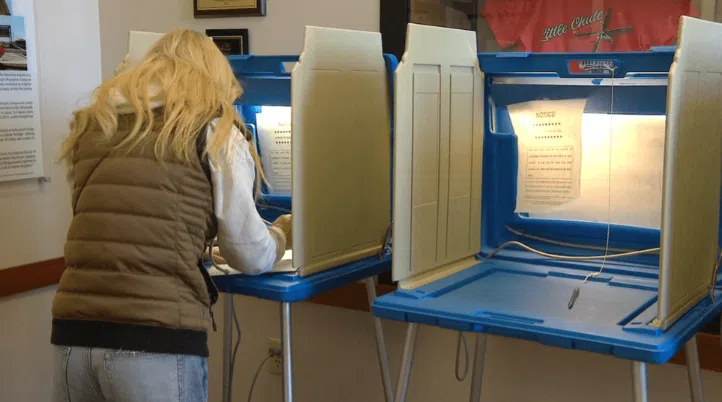
(WTAQ-WLUK) — A democracy approaching its 250th birthday is reevaluating how to conduct its most democratic practice: voting.
Last week, New York City voters elected Zohran Mamdani to be the Democratic nominee for mayor. Less than two weeks ago here in Wisconsin, Democrats picked Devin Remiker to be the new party chair.
Both candidates won through a process called ranked-choice voting.
Wisconsin still uses the conventional voting system, but a ranked choice system called “final five” was proposed two years ago.
There are many ranked choice voting systems. In New York City, voters ranked their top five candidates. Wisconsin Democrats ranked all three candidates.
Lawrence University professor of history Jerald Podair explained its benefit:
They want it to accomplish a goal of having most people walk out of that room and say, ‘You know what, I got a candidate who was acceptable to me,’
Let’s take a deeper dive into the perspective of the final five proposal. We’ll start with the primary.
The process
“Final five has an open primary, meaning that you can cross over and vote for whoever you prefer,” said State Sen. Jeff Smith, D-Brunswick, who coauthored Wisconsin’s proposed final five bill in 2023. “One vote, so you don’t rank them there. And then the top five vote-getters move over to the general election.”
Basic facts about the primary:
- Open primary (no Republican or Democrat)
- Voters choose their favorite candidate
- Top five vote-getters move onto the general election
In this proposal, there is no ranked choice voting in the primary.
Then, the five candidates compete in the general election.
“That’s when it becomes ranked choice voting,” said Smith. “You rank them according to your preferences.”
Will it lead to more polarized candidates or less?
Rep. Ron Tusler (R-Harrison) sponsored the bill in 2023.
“What this system did, is it created incentives for Republican to go after Democrat votes,” said Tusler. “Even if the Republican isn’t going to be the first choice, there’s a lot of incentive to be the second choice.”
Added Tusler on who it might benefit: “People that are more into moderation, people that are more diverse, people that aren’t really extreme on one end or really extreme on the other end.”
Critics say the candidates would form alliances if they align ideologically, as was the case in the New York mayoral race, when two candidates co-endorsed one another.
“It allows you to stay in your ideological lane. Basically, you can make deals with others who are right on the same ideological page with you, but not reach across the aisle,” said Podair.
Could it change the two-party system?
Smith thinks it could.
“I think it actually opens up the possibility of more people willing to run on their real values,” said Smith.
It’ll be an uphill battle since the existing political powers want to keep the status quo, according to Smith.
In this format, if five candidates have a legitimate chance, they could have more unique views than the two-party system which primarily elevates the party platform. The question is whether five candidates would have a legitimate chance.
Smith and Tusler hope to revisit the idea of ranked-choice voting once people understand the concept better — perhaps even as soon as next year.
“It took me awhile to figure it out,” said Podair. “And I’ve studied politics now seriously for 60 years.”
With Alaska, parts of Maine, New York City, Minneapolis and San Francisco now partially or fully adopting the ranked-choice voting system, it could be time that Wisconsin voters begin to understand it. And with it still relatively new in other parts of the country, some unintended consequences have yet to be worked through.


