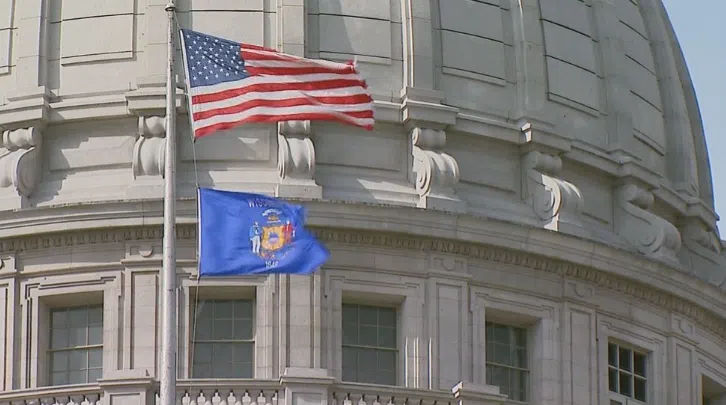
(WTAQ-WLUK) — Wisconsin Democratic state lawmakers hope to alter how the state’s votes are allocated to the Electoral College after gaining control of both legislative chambers and the governor’s office in January.
According to the plan, Wisconsin’s 10 electoral votes would be cast for the winner of the national popular vote, not the state’s own vote.
“In a democracy, the person who gets the most votes should win the office,” said State Sen. Kelda Roys, D-Madison, who’s leading the effort. “There is only one elected office in this country for which that is not true, and it is the presidency. Americans and Wisconsinites deserve to know that our president is the person who received the most votes in all 50 states, and all of our votes deserve to count equally.”
Recent elections where this would have changed Wisconsin’s vote:
- 2016: Wisconsin voted for Donald Trump, but Hillary Clinton won the national popular vote
- 2004: Wisconsin voted for John Kerry, but George W. Bush won the national popular vote
- 1988: Wisconsin voted for Michael Dukakis, but George H.W. Bush won the national popular vote
“This would undermine that balance and disenfranchise Wisconsin voters by letting results in other states override their choice,” State Rep. Tyler August, R-Walworth, a state Republican leader, told The Associated Press.
Plan hinges on interstate compact
The plan would hinge on three more states joining an 18-state compact. The laws, which have been signed only by Democratic-leaning states, don’t kick in until the states in the compact total at least 270 electoral votes, currently at 222.
However, five new states will soon be under full Democratic control, including Wisconsin, clearing a potential path for the legislation.
Bill will face lawsuit
The Wisconsin Institute for Law and Liberty has already pledged to pursue litigation against this.
“The Constitution is very clear that any compact or agreement amongst the states has to first be approved by Congress,” said Deputy Counsel Lucas Vebber. “This one has never been approved by Congress.”
Vebber is referring to Article 1, Section 10, Clause 3, which prohibits any state from “enter[ing] into any Agreement or Compact with another State.”
Roys said she believes this will hold up, saying that case law shows this clause refers to powers given to the federal government. The power to govern voting is a power given to states, not the federal government.
Would Roys seek Congressional approval if the necessary states pass this?
“I think at that point the states would have already approved it, and so I think it would be in effect.”
The Constitution lays out the Electoral College but doesn’t require states to pledge their electoral votes in a certain way.
Vebber also argues this raises questions about equal protection and subverts the Constitutional amendment process.
“It’s an attempt to effectively amend the Constitution without actually amending the Constitution,” said Vebber. “If people aren’t happy with the Electoral College as it’s written in the Constitution, there is a mechanism to change that, and it’s the constitutional amendment process. This end run around it is not the right way to do that.”
Democrats say this is a secondary, not primary issue
I asked Roys, State Rep. Lee Snodgrass and State Sen. Kristin Dassler-Alfheim, the latter two since they both represent Appleton, how important of an issue this is.
“I really didn’t hear about it at the doors,” said Snodgrass. “I’ve heard about it more since we’ve obtained the majority. We’ve had a few calls to my office, both pro and con frankly… Really what people have asked me to do is to make sure that their wallets are in a better situation, that it’s easier for them to just get by day-by-day.”
Snodgrass and Dassler-Alfheim say they support this, but are first focused on delivering on affordability.
Democrats introduced this bill earlier this year, but it failed to garner any support from Republicans, who held the majority in the Assembly and Senate. The new legislative session begins on Jan. 4, 2027.




