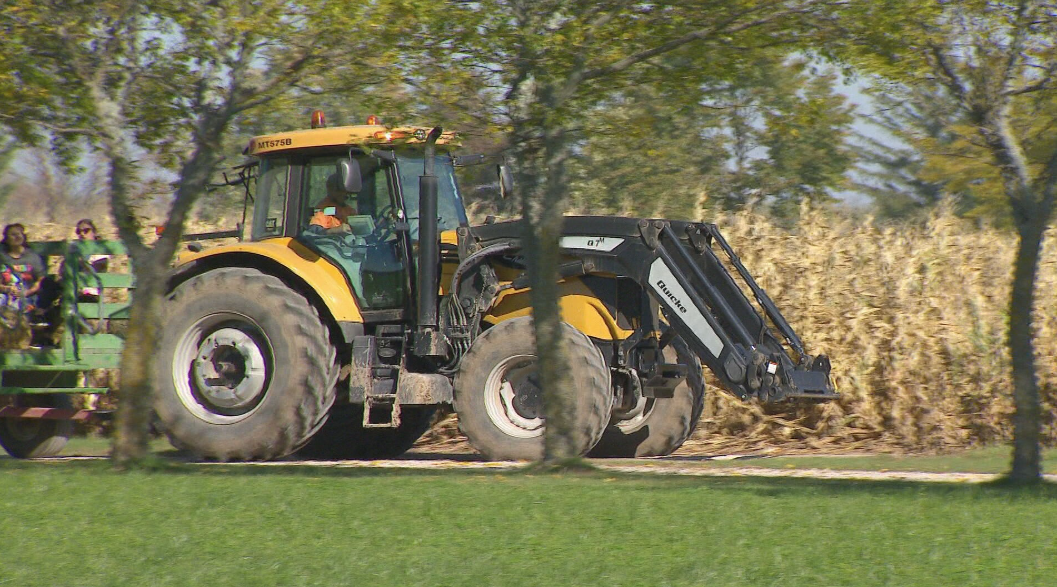
Some financial relief is on the way for American farmers from the Trump Administration. The USDA will make a one-time $8 billion payment to farmers as input costs rise. Oct. 21, 2026. PC: Fox 11 Online
HILBERT, WI (WTAQ-WLUK) — Some financial relief is on the way for American farmers from the Trump Administration.
The USDA will make a one-time $8 billion payment to farmers as input costs rise.
It also comes at a time when diesel still costs over $6 per gallon.
Mulberry Lane Farm in Hilbert says it’s becoming more and more of a challenge to keep up with high fuel costs.
They’re doing everything they can to keep from raising prices on customers picking out their favorite Halloween pumpkins.
“We haven’t increased our rates in several years, and we’d like to keep it that way. Everyone’s suffering. So rather than pass on that expense to our farm guests, we’re just trying to eat it ourselves,” Mulberry Lane Farm co-owner Bonnie Keyes said.
Keyes said despite this, high diesel prices have cut into their bottom line.
Last year around this time, the farm paid about $700 to refuel– on Wednesday, it cost them more than $1,200.
Now, the Trump administration is rolling out an $8 billion one-time payment to help farmers.
Keyes has her reservations on if this will help.
“I’ll believe it when I see it. And what’s the red tape? There are a lot of government programs, but for the farmer and his wife to sit down at the kitchen table and try to maneuver through all the paperwork, sometimes it’s not worth it,” Keyes said.
Keyes said this will likely be more helpful to large farms with a lot of land, not small farms like hers.
The Harvest Fuel Relief Program is meant to aid farmers impacted by high fuel and fertilizer costs.
UW-Extension Assistant Professor of Agriculture and Economics Jeff Hadachek said the money should offset what farmers spent on diesel.
“Fuel is a pretty small component of… total farmers’ operating costs. Depending on the crop, it’s something like 2 to 5% of overall operating costs,” Hadachek said.
Hadachek said things like seed, fertilizer and land have higher operating costs than fuel on a farm, but calls this a band-aid solution.
Back at Mulberry Lane, Keyes is hoping for a stronger long-term solution to help all farmers.
“We’d certainly love to just see the prices go down. That helps everybody across the board,” Keyes said.
The USDA said payment rates are expected to be announced in November.
How much individual farmers will receive and when payments will be distributed has not yet been announced.




Comments