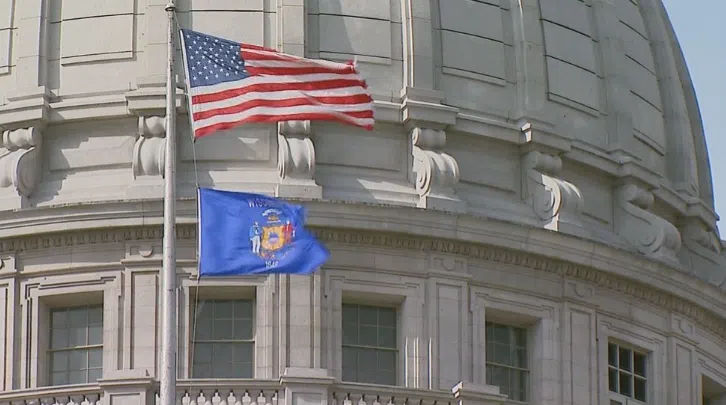
Wisconsin state capital in Madison. PC: Fox 11 Online
(WTAQ-WLUK) — Wisconsin has a $3.3 billion surplus and state lawmakers are discussing how it should be used.
A new report from Forward Analytics, a non-partisan Wisconsin research organization, shows Wisconsin’s financial cushion is shrinking.
The state ended the 2026 fiscal year with $3.3 billion, which is far less than the $4.6 billion the state started the fiscal year with.
The report said the state spent and transferred more money than what it collected in revenue.
State Rep. David Steffen, R-Howard, is mindful of the state’s smaller financial buffer, but isn’t concerned.
“Remember that in the history of the state of Wisconsin, there’s only been one year in our 170 years as a state that we’ve ever collected the same or less money than the year before,” Steffen said.
Steffen said it’s important that over half of the $3.3 billion goes back to the taxpayers.
The rest of it he’d like to see be distributed between classrooms and communities.
“The money just sits there earning well over a million dollars a month in interest and in my opinion, that’s if there is an overpayment by the people, they should get a refund,” Steffen said.
The analysis also points out the surplus is one-time money and shouldn’t be used for recurring expenses, and Steffen agrees.
A retired UW-Madison economics professor said the money should be used with caution.
“That $3 billion state surplus can go away very quickly and it’s certainly there’s no guarantee and it’s unlikely that we’ll have a repetition of having a big surplus,” UW-Madison Emeritus Prof. of Applied Economics Andrew Reschovsky said.
State Sen. Jamie Wall, D-Green Bay, also agrees.
However, he worries about future economic uncertainty and thinks the surplus should be used conservatively.
“We’re already planning on spending more than we’re taking in as a state over the next couple of years and so that balance in the checkbook is just gonna decrease naturally. So, probably, we’re not gonna be able to do everything that everyone has ever thought of,” Wall said.
Wall opposes one-time rebate checks, arguing the state should prioritize property tax relief by putting more money toward public schools.
“And then we should look for you know some one-time spending or you know or tax cuts,” Wall said.
As lawmakers look ahead to the next state budget, they’ll have to weigh how to use the remaining surplus while preparing for future financial needs.




Comments